
On Being Photographed
... or 'Becoming Part of Porto's Scenery'

I have 19,175 photos on my phone.
5.3 billion photos are taken daily - 61,400 per second.
14 billion images are shared daily on social media, with 6.9 billion WhatsApp alone.
There are around 14.3 trillion photos in existence, and this number grows by 6-8% a year.1
This is the story of one of them.
… any ethics that persistently considered works of art more valuable than human life was no ethics at all - Teju Cole, ‘Tremor’
It was late afternoon one recent autumn Friday and I had arrived at the fountain by the Art Deco cinema2 in Batalha to meet my friend, L., for after-work Friday drinks. After-work for her. The joy of freelancing is that I can give myself Fridays off, but I see no reason to forego the ‘drinks’ part.
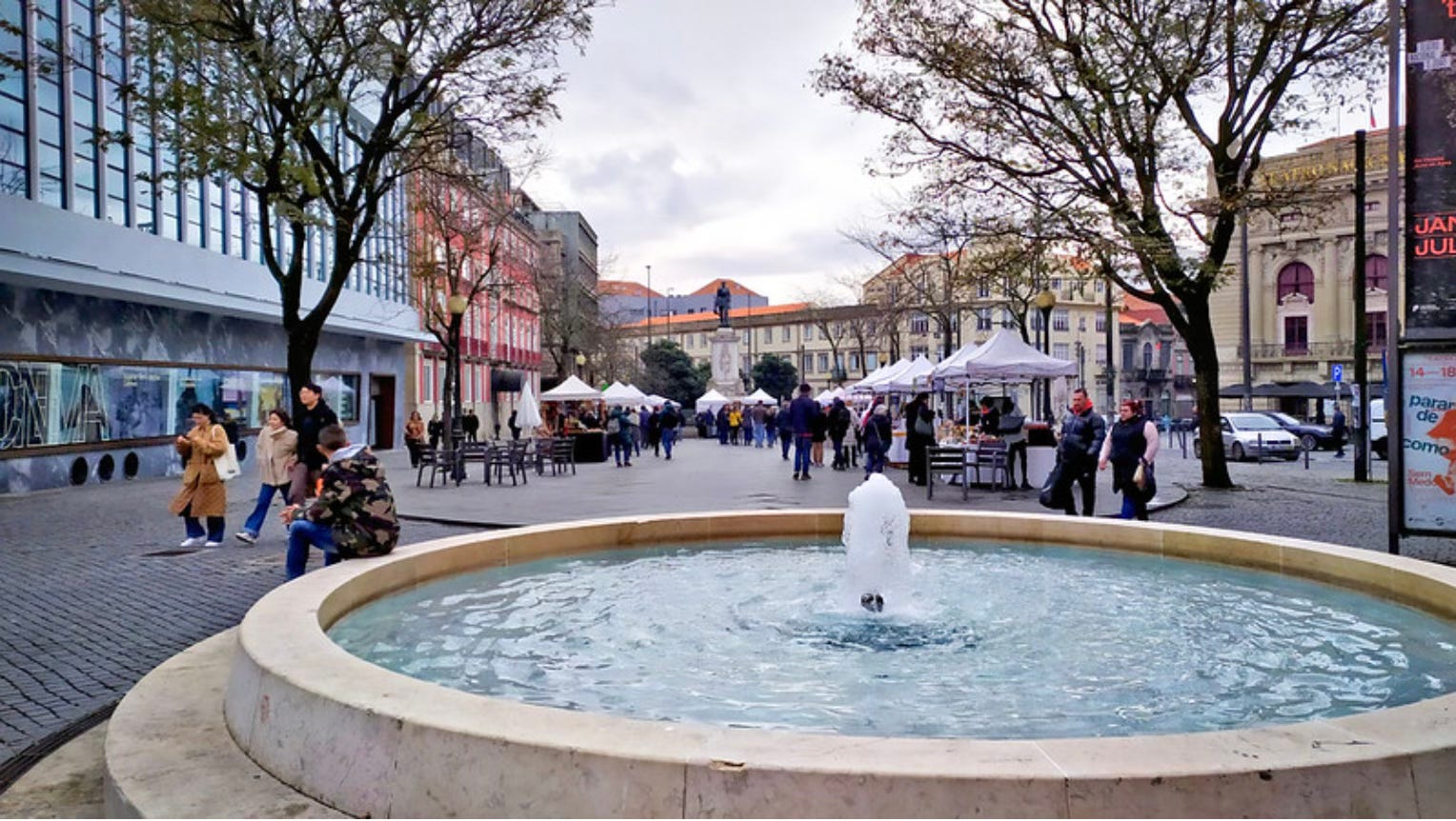
I’d arrived uncharacteristically early. In the past, back in my old life, I’d have used every waiting minute to scour through unread emails or WhatsApps, bash out hasty responses, label, delete, but that was then.
Now, as I sat with others who had also clearly designated the fountain as a meeting-place, for the next 20 minutes I just watched life play out around me: a teenage couple squatting on the pavement, lighting up a joint under the cinema’s overhang; a father and son, hand-in-hand, huge smiles across their matching faces, jumping over wet drain covers; tourists - always tourists! - meandering past, gazing upwards at the buildings, or checking their phones for directions; a woman I guessed might be homeless successfully cadging a cigarette from a young man by a market stall.
In so many ways, this could be any city scene and yet Porto itself changes everything. It doesn’t matter how often you wander its streets, nor what your purpose is for being there, but there is always something that will stop you in your tracks, pique curiosity, or arouse a sense of marvel, or just sheer pleasure at its rumble-tumble architecture, the higgledy-piggledy cobbled streets that wiggle their way impossibly up and down Porto’s many inclines, or those glimpses through archways into hidden enclaves.
And so sitting by the fountain in the fading light, my red raincoat hood pulled up over my head as gentle drops of rain started to fall, I found myself enjoying the time to think and to catch my breath, and then just to not really think, just to watch and to find my breath slowing down to that long, internal ‘ahhhhhh’ that I still sigh when I realise that, despite immigration challenges, despite the difficulties in getting back ‘home’ to see our family and friends - despite all that, this is just where I live. This is my normal now.
And then I saw him—probably around my age, probably also recently retired, but still able to afford decent casual clothes—standing about six meters away, pointing his rather fancy-looking camera at what I assumed was the fountain where I was sitting.
Thinking I was in his way, I gestured that I’d move, but he went a bit pink and waved, in that embarrassed, apologetic way—oh no, no—turned around and disappeared into the market in front of me.
But then after a few minutes he reappeared. He stood directly in front of me, legs slightly akimbo, poised with the camera just so, and pointed and clicked.
This time, it was me who felt really embarrassed. But then I got annoyed.
He had no idea who I might be nor what my circumstances might be. And, more to the point, he must know that I had no idea why he would be taking my photo. Would it not occur to any reasonable man that taking a photo of a woman—or of anyone—without their permission is a violation of privacy?
By the time I’d really processed what had happened, he’d moved away, but I watched him then taking photos of the kids with the joint, and the homeless woman with the cadged fag. A little part of me thought, ooh, I must look like a local now—some part of Porto’s street, ‘grunge’ aesthetic. It should have been a nice feeling - to look like I belonged, that I blended in.
But mostly I felt annoyed. Annoyed that he felt he just had the right to take our photos - mine, the kids’, the homeless woman’s - and now they are his, sitting on his camera, shared on his social media, turned into arty shots of Porto, who knows?
I wanted to know what he saw, and what he thought he was making with his photographed plunder - and it went against everything that I understand as being human: to come, take something from someone, and never ask permission, never explain what you’re planning to do with it - just take. It felt completely de-humanising.
And he reminded me of Tunde, the protagonist in Teju Cole’s autofiction novel, Tremor, who, when visiting the Eiffel Tower, suddenly spots in the scene of street vendors by the Eiffel Tower a visual echo of a 2016 photograph by Alessandra Sanguinetti: The vendor, Jardin de Tuileries, Paris3.
Now, I have no idea what that tourist-photographer saw when he felt compelled to photograph a 60-year old woman in a red raincoat, perched on the edge of a fountain in a greying city scene. (His follow-up shots gave me some clues, though!).
But what I do know is that, like Tunde, he:
…was a stranger who had simply looked past him and taken something the way the wealthy take what belongs to others and then act surprised when they are challenged. Taking. That’s what those who are well-off do. They take and take and take.
Cole writes of Tunde having wanted “to make a photograph” rather than simply take one. The distinction matters: it turns a thieving act into a creative one.
When photography was first invented, people were scared that the camera would steal their souls, and it is still a belief held in some parts of the world, not dissimilar to the old idea that mirrors were soul-snatchers.
I don’t think that that tourist stole a part of my soul. But he did manifest that privilege which Cole frames in colonialist terms—the unquestioning acquisition of things that simply don’t belong to him. He hadn’t asked for permission … hadn’t even considered doing so.
It’s a losing battle, I know. If you manage to read to the end of this, you may want to ponder the fact that around 30 million photos4 will have been taken in the 8 minutes or so it’s taken you to get from start to finish.
A couple of hours later, and after a favourite glass of stout and much meandering conversation with L., I emerge onto the wet, glittering night-time streets of Porto and stroll easily down to the Ribeira to head home, the incident with the photographer still posing a conundrum.
On the way, a jolly group of women and their young kids, puffing up the hill towards me, stop me and ask: Onde é a estaçao de São Bento? Barely skipping a beat, I smile and point them up the hill in the direction they were already heading, and reply É por aqui, acima. One of the younger women - swaying a little perhaps from an irresistible extra glass of port wine - gives me a big smile and a cheery obrigadíssima!
The Ribeira looks magical, all the different coloured lights glittering on the wet paving stones and then reflecting in the Douro. Porto at night in the rain is exquisite - gleaming and bejewelled. Umbrellas of every colour unfurl like flower petals held aloft by fairy-folk.


By the waterside, a beautiful young Spanish woman approaches me and, offering me her smartphone, asks if I can take a photo of her and her beau standing with the classic Porto backdrop - the Dom Luis Bridge, the Mosteiro da Serra do Pilar tonight glowing with purple lights, the moored-up rabelos looking like they’ve been dressed up for Christmas.
Accepting her smartphone, I smile encouragingly and appreciatively at the lovers as they stand there doing what millions have done before them and millions will, no doubt, continue to do, and capture them. A few times, just to be sure. In that moment, that iconic backdrop is transformed and made unique by their beaming faces as they pose, his arm wrapped proudly around her, her eyes twinkling into his.
She thanks me warmly, and as I cross the bridge to go home, I picture that photograph on their Instagram feed, and then one day, perhaps, being looked at by their kids, who’ll marvel at how young and beautiful their parents looked then, thinking (maybe) that one day they must visit Porto and see how much it’s changed since before they were even twinkles in their parents’ eyes.
I’ve found myself reflecting on this experience quite a bit after it happened, wondering why it made me feel so uncomfortable, and questioning my own practices as someone who also loves taking photographs, especially in a city as vivid and vibrant as Porto. I’d like to think that I am more respectful when taking photographs of people - I stopped videoing the magpies’ funeral, for heaven’s sake! - but where is the line?
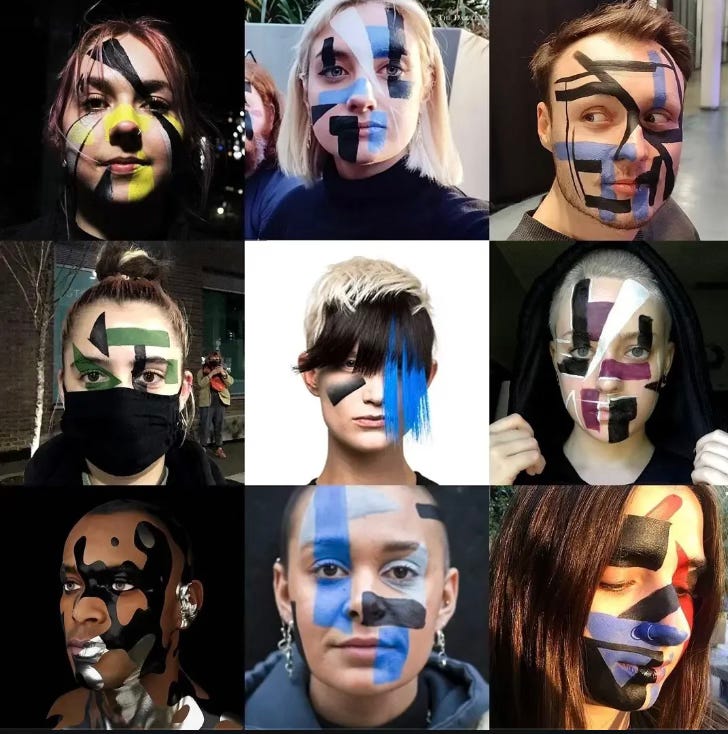
And all this rumbles around with a growing sense of concern at the prevalence of surveillance in our world, of facial recognition software that is increasingly unavoidable, and human rights groups5 having to inform the world’s citizens how we might avoid having our faces ‘captured’ for databases without our permission or control - although kudos to those using ‘dazzle’ make-up to ‘scramble’ the cameras6, and to the Danish government with its proposed amendment to its Copyright Act which, if passed, will grant citizens three fundamental rights: the right to demand immediate removal of any AI-generated content using their face, voice or body; the right to claim compensation for damage if their image is used without authorisation; and the right to these protections regardless of proving malicious intent7.
I’d love to know your thoughts! Do you like being photographed or looking at photographs of yourself? Does it matter who’s taking the photos, or where they will be shown/seen? Are you more cautious today about sharing ‘selfies’ or other images showing people you know on social media? Do you enjoy taking photos of other people? Do you seek permission? Do we need to, especially now when it’s so hard to keep control over who has access to images of our faces?
This essay is a regular ‘Borboleta Letter’. I hope you found it thought-provoking, if nothing else!
And if you are not yet a subscriber, do consider joining our community of open-minded, curious, reflective folk who also flutter by to read these Letters and share their ideas and experiences in the comments.
Free subscribers receive regular letters (including ‘Flittings’ and Borboleta’s Reading Journal) along with access to the past 3 months of essays in the archive; paid subscribers will also receive weekly ‘Postcards from Portugal’ plus full access to the archive.
Até à próxima, os meus amigos!
Michelle 🦋
Sources: https://photutorial.com/photos-statistics/ and https://www.makeminedigital.com/AboutPhotos
https://pt.wikipedia.org/wiki/Batalha_Centro_de_Cinema
I assumed the photo is copyrighted but you can see it here: https://bombmagazine.org/articles/2017/05/09/alessandra-sanguinettis-le-gendarme-sur-la-colline
61,400 photos are taken every second, making that 3.7 million per minute. Source: https://photutorial.com/photos-statistics/#how-many-photos-are-taken-per-second-minute-hour-etc
e.g. https://www.liberties.eu/en/stories/anti-facial-recognition-mask/43570
https://www.theguardian.com/world/2020/feb/01/privacy-campaigners-dazzle-camouflage-met-police-surveillance
https://thegoodlobby.eu/denmark-gives-everybody-the-right-to-their-own-body-facial-features-and-voice-to-counter-deepfakes/
I have so many thoughts. Will need to distill them. But I love taking photos of people, but mostly of people I know. I know people, including here on Substack, who post a lot of photos of other people, which they have taken without the people in the photo knowing it. I do think it is problematic. I recently posted a picture in a post- a photo I took many years ago in a bus in Paris and none of the people in the photo were asked for permission, but since it is a random photo of bus passengers, is that ok? I wonder. I've had my photo posted on Substack without my permission too. Definitely not ok.
I also love how you've woven Tremor into this. It is interesting because Cole is a photographer as well as a writer, but his photos, if I am not mistaken, rarely, if ever feature any humans.(and bravo for helping with street directions to people in Portuguese :-)
Interesting post, raises thought-provoking question. Ted was a street photographer back in the day before the proliferation of AI, social media, facial recognition. He shared he used to take photographs without permission unless he sensed discomfort. He thinks now his approach merits rethinking.