
Art for Whose Sake?
Reflections after visiting the Vivian Maier exhibition in Porto

I. … and there was Mr Tansley whispering in her ear, “Women can’t paint, women can’t write ...”1
So goes the soundtrack that plays through Lily Briscoe’s head almost to the close of Woolf’s novel, ‘To the Lighthouse’, as the young artist, infatuated with Mrs Ramsay, struggles to capture her ‘vision’ of her on canvas.
One question persists: how can you ever really know anyone, “sealed as they were”? That question along with Lily’s attempts to understand, not only the why of the love she feels for Mrs Ramsay but the how of expressing that, occupy a main arc of the story, and only conclude in its final line.
Trying to capture Mrs Ramsay on canvas, Lily grapples with the disconnect between the physical act of seeing what’s materially there and the deeper sense of seeing as knowing. What is it that makes a person who they are, beyond their worry-lined brow or eyes screwed up in concentration or hands busy with a chore?
And while Lily tries to give expression to the inexpressible through a purple triangle on white canvas, Mrs Ramsay spends her days knitting socks for the lighthouse keeper’s son, or overseeing the cook making boeuf en daube from an old French family recipe for a dinner party.2
For Woolf, both women are artists - artists whose creativity is either dismissed (‘can’t write, can’t paint) or seen simply as some innate part of being a woman, and therefore of no real value.
“... what have I done with my life?” questions Mrs Ramsay, “taking her place at the head of the table, and looking at all the plates making white circles on it.”
II. ‘She made her work entirely for herself’3
I first read To The Lighthouse when I was 16 and starting A Levels, and something about both women lodged in my psyche and I don’t think it ever really left.
I’ve always made stuff, especially as a kid and into my teens where a lack of skill counted for nothing next to the sheer pleasure and absorption my ‘making’ gave me. I’ve written stories and poems and journal entries for as long as I can remember. I had a writing den in an old coal shed in our garden when I was a kid, and I wrote terrible plays that I made my sisters perform. They would shift quickly from horror to total ridicule as they went all ‘Bottom and the Mechanicals’ on me while I tried desperately to retrieve my imagined fairytales from their grubby grips!
But later the English degree that I dreamed might turn me into a Writer with a capital ‘W’ instead left me terrified to put pen to paper. Three years’ spent reading the ‘greats’ and trying to wrap my brain around the symbolism in “The Wasteland” or the intellectual and sheer novelistic complexity of Middlemarch - I mean, why would I even try to write anything when nothing could stand up to writing like that?
Can’t write, can’t paint … Charles Tansley stomped around my head.
Woolf’s was a distinctly feminist message articulated through the evident shallowness and ego of this philosopher ‘fan boy’ (he idolises Mr Ramsay) but my sense of inadequacy always felt to me to have come from a slightly different place, even if we may ponder its fundamental foundations!
So instead I took to other creative things, usually involving wool or thread, which were less about a need to demonstrate any kind of skill but instead for the sheer pleasure of using my hands to make stuff, usually to offer as rather lame gifts that I’d apologise for but only ever give to people who accepted that it was the thought that counts!
But recently that’s changed. Perhaps moving to Portugal has helped me to cast off at least some of those feelings, or maybe more the part of my identity that insisted I can’t. A kind of metamorphosis that I’ve both whimsically and more seriously explored in writing here on Substack, and now even in a Writers’ Group in Porto which I found myself volunteering to set up and run!
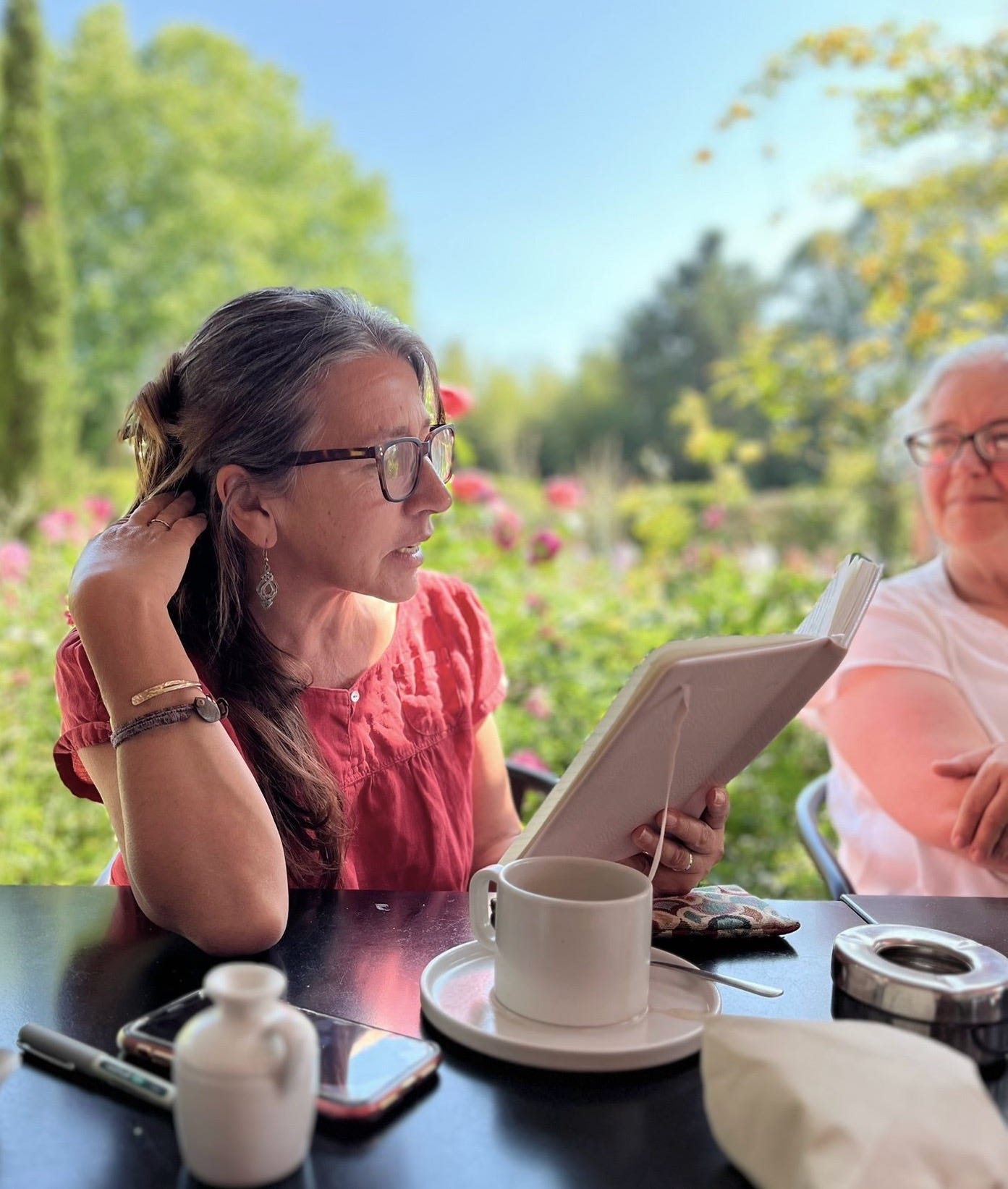
Recent discussions about evolving into a critique group, though, have left me wondering: what motivates a person to want to write (or paint or make anything) just for themselves?
It was with this question in the back of mind that I found myself at the Vivian Maier exhibition currently in Porto, and discovered that I wasn’t alone!
III. ‘I love people’s faces’
The Centro Portugues de Fotografia, Porto’s Cadeia da Relação (Prison of the Court of Appeal for almost 200 years4, turns out to be a very fitting site for this exhibition of photographs of mostly people and the architecture of the streets of New York and Chicago, taken mostly in the 1960s and 1970s, by a nanny who never shared her work with another soul - work which was only discovered months before she died.
On arrival, you find yourself entering what used to be the Prisoner’s Courtyard where vertical banners of Maier’s black and white images hang suspended from the window frames and ledges. The pictures offer up a wealth of people - a few celebrities like Kirk Douglas and Audrey Hepburn initially stand out because familiar to us, before our eyes are drawn into the faces and postures of the unknown folks Maier captured on the streets of Chicago and New York, and who populate the majority of this exhibition.
Craning your neck to scan these images up and down, visually scaling the towering walls and barred windows of a building that seals itself at the top with a skylight to the outside world, you are being inducted, viscerally, into the world Maier both inhabited and created.
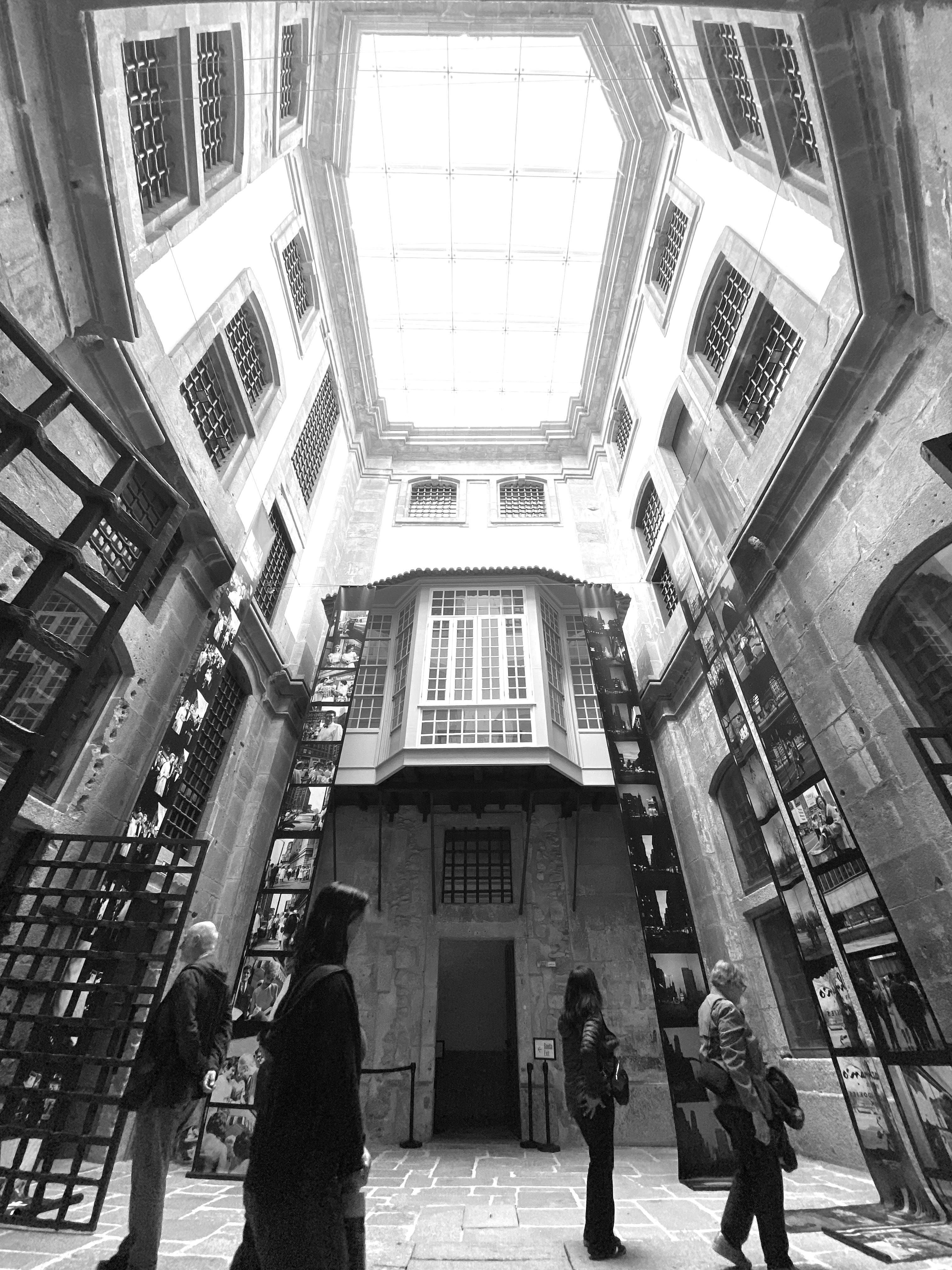
The discomfort of this act - of looking up towards the light - reverse-mirrors how Maier must have taken her photographs. The double-lens Rolleiflex camera she mainly used required that she look down through the focusing screen where the image would have been seen laterally reversed (mirror-image, left to right). She would not have looked directly at her subject, nor would they have seen their ‘captor’ doing anything other than looking down through the machine. This negation of eye-contact between Maier and the human subjects she appears to create such connection with is perhaps one of the most palpable paradoxes that contribute to how compelling audiences now find her work.
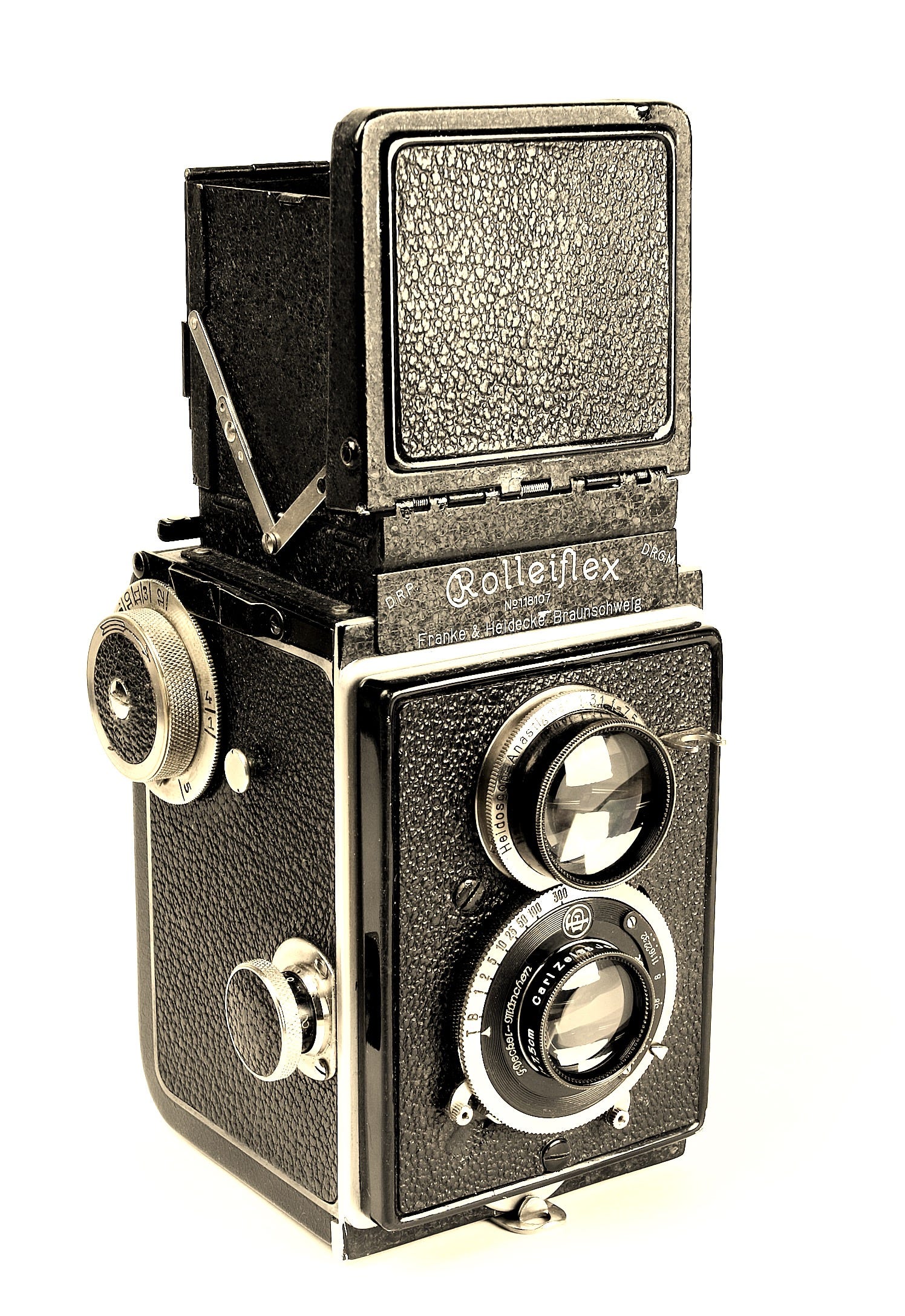
One of the children in a neighbourhood where she worked tells how ‘Miss Maier’ (the only name she’d allow anyone to call her by) would suddenly stop on one of the long, long walks she regularly took around the city streets, kids in tow. Noticing nothing else that was going on at that moment, she would stare down into the screen focuser and fix the camera’s position while she made her picture of whoever or whatever had arrested her attention.
Was she bestowing meaning on the over-looked, cast-off, forgotten that dominate her pictures, or inserting herself into the place that afforded her belonging? As if for a moment breaking into someone else’s world might give meaning to her own?
The sense of confinement in the old prison we now find ourselves standing in arrests us, in the way we might imagine Maier looking through the focusing screen of her Rolleiflex, completely stilled and intent on capturing her subject.
Her subjects presented in this exhibition are mainly the street scenes of Chicago and New York for which she has become iconic, and these seem to hold life’s kaleidoscope in their (mostly) black-and-white prints. While Hollywood celebrities might smile out at us from the courtyard’s vertical banners, it’s Maier’s peripheral gaze we are invited to look through as we walk around the 4 exhibition rooms (once prison cells) to see the people and places and objects that are otherwise rushed past: the poor, the homeless, the social underdogs, the kids, the discarded newspapers, the building facades that have temporarily escaped the bulldozer, and just people - everyday people going about their everyday lives, without fanfare.
It’s hard, we got our heads down and our hackles up
Our backs against the wall, I can feel your heart racing
None of this was written in stone
The current’s fast but the river moves slow
And I can feel things changing
Even when I’m weak and I’m breaking
I stand weeping at the train station
‘Cause I can see your faces
I love people’s faces
- Kae Tempest, ‘People’s Faces’
A contemporary fixation on ‘discovering’ just who Maier was perhaps over-emphasises her Mary Poppins-branded eccentricity, with what little has surfaced of her life imbuing that with associations of recluses and hoarders and those who live on the fringes. We wonder how this abandoned child who spent her life looking after other people’s kids could produce such an extraordinary body of work that she is now considered one of the 20th century’s ‘greatest photographers’?
It’s credit she would never have known in her lifetime, and that many people who’ve worked closely on her photographs since, or who homed her as their nanny, suggest she would never have wanted.
IV. '‘Tell all the truth but tell it slant’5
So why do it? What drives such a compulsion to go out onto the streets and to do more than to document them but to make them into something that holds a meaning you never plan to share with anyone else?
“Artwork isn’t artwork until it’s shared.” (Jeff Goldstein)
For our selfie-obsessed culture, it’s a curious thing, to say the least.
But humans have made art for as long as there have been humans.
We make art to connect with others, sure, but we also make art just because that’s how to make our imaginations manifest, and sometimes that’s all we need to do.
Lily Briscoe expects that her painting “would never be seen; never be hung even” but still she spends 10 years trying to paint it because it’s the only way she knows to give expression to the ‘truth’ of what she knows about Mrs Ramsay. And that truth is one that matters only to her.
Maier’s ‘truth telling’ also tells it ‘slant’: in one of the few pieces of writing we have by her that reveals anything much, she describes herself as being a bit like a spy. Street photographers often understand their work as a form of documentary, but there’s something else about Maier’s positioning and framing - as well as her own intriguing self-portraits that are so often not even the overt subject of the image - that might remind us of some of the ‘Old Masters’ who painted portraits in their own image or hid secret ‘tells’ of themselves somewhere in the painting.
When I look at some of her self-portraits, I see someone who seemed to be having quite a bit of fun. There’s a mischievousness to the images, with the deadpan stare at a shop window, or a fractured visage in a wing mirror, or a silhouette in a puddle. She was experimenting, playing, and doing something really innovative as any artist does.
“She followed her inner line of curiosity … the amateur doesn’t do that” (Joel Meyerowitz, photographer)
But there was something deeply serious going on here too, there’s no denying. Seeing herself in others, taking their photos, she was expressing her attention to them. Demonstrating that she noticed them, even when nobody else did. And by imprinting herself into their lives and onto this urban landscape - as a reflection down a water-pipe, or a shadow on the pavement - she was making sure that she left a mark, too, giving presence to the unseen, and to the ghosts.
V. The Great Escape
The prison setting with its unignorable motifs of ‘capture’ and ‘escape’, of the ‘arrested’ and the ‘locked away’ certainly offers a potent space in which to explore Maier’s images, in large part because it connects rather ironically, too, to the story of how the world came to find out about her work.
For over 60 years, Maier’s photographs remained unseen by anyone but herself, and then only, for a small fraction, as prints that she either developed or had developed in local chemists. The vast majority of negatives, slides, film reels were stored in her bedroom in the homes of the families she lived with, until space demanded that she rent storage units to hold it all. When she defaulted on her payments, and the contents were auctioned off, the 150,000-plus negatives, hundreds of rolls of undeveloped film, and quantities of reels of home movie footage were released from their captivity, into the unsuspecting hands of a few amateur photo collectors or simply people curious enough to see what treasures, if any, might have been stashed in those units.
There was one man (John Maloof), who had been tasked by the publisher of a book he was co-authoring about Chicago’s Northwest Side, to find over 200 vintage photographs of the area and when he landed on a box of negatives of 1960s Chicago street scenes, paying $380, his instinct told him he might have hit gold. Maloof would go on to build the collection of Maier’s work that the public can now see, but tens of thousands of photographs are still out of the public eye, either in the hands of private owners who simply won’t part with the photographs they happened upon in that auction in 2007, or are still to be developed - and brought into existence for us all to see.
While Maier’s entire story might be mapped onto themes of elusion and discovery, of secrecy, the hidden and spying, it also raises some interesting questions about just whose work we’re now really seeing when we stand in front of the 100+ photographs in an exhibition.
Maier’s photographs are the raw material, but she didn’t create the prints we see, nor did she curate the collection which inevitably offers narratives she did not ‘write’, but that others have done, from the fragments she’s left us.
Yet as Lily Briscoe and Virginia Woolf suggest, the urge to “know” a person or a life is never an objective act of recovery, but a creative one. Faced with fragments, we don’t simply uncover meaning—we construct it, shaping a version that can never be complete, and will always be mutable and malleable.
In that sense, our engagement with Maier’s work mirrors Lily’s struggle to render Mrs Ramsay: an attempt to fix something inherently elusive. I think this is one reason Maier’s photographs exert such a powerful pull on audiences, both in galleries and online—we are not just looking, but participating in the act of making meaning, which itself is a kind of art.
VI. Art for My Sake
Spending time looking at and then thinking and writing about Maier and her photography has led me to re-embrace the notion that creative output doesn’t automatically have to be shared to have value.
It is still possible to take a photograph for yourself.
To write a poem for yourself.
To paint a picture for yourself.
You do not need to tell the world about it on Facebook (or Substack!) for it to hold importance, to give it existence.
There is a deep irony in the fact that Maier’s work is everywhere on the internet. I think she’d have hated that.
And it reminds me of the dilemma I found myself trying to tease out back in November when that guy took my photograph at the fountain in Batalha. No consent was given. I’ve wondered just how Maier really did interact with her subjects? And now we’ve taken Maier’s work. We exhibit it, write about it, take our own photographs inspired by it - and chances are, if we’d have been able to ask if she wanted it shared to the world, she’d have said ‘no’. She died a little over a year after her work had been sold, and likely had no idea of the fame it would procure for her.

********
This piece - in its draft forms - took off in so many directions, as if it has a life of its own that I’m struggling to net.
But one powerful thing has emerged for me through the process, and that is the validation of making for myself. The photographs I take as I clamber over the rocks and look into rockpools on my local beach; of fading facades on the old warehouses I walk past to go into town; a bird singing on a branch - blurry but I know it’s there and the act of photographing allows me to pause, and to really see what has caught my notice. The diary I keep that helps me to work out what I think. The embroidery I’m working on (for a very private audience!) that is at least as much about finding a way to process complex emotion as it is about creating a gift.


Perhaps the revival of my enjoyment in ‘art for my sake’ might be considered a repayment of sorts, and a way to pay homage to a woman who never wanted anyone to see what she made. She just wanted to make it.
Are there creative things that you do, purely for yourself? Why?
Does art have to be shared to be art?
For anyone reading this who can get to the exhibition, I strongly recommend it. And if you can’t, but your curiosity has been piqued, you might want to check out the BBC Imagine documentary (2013) which pieced together the fragments we have about Vivian Maier in a characteristically thought-provoking way!
Até a próxima, meus amigos! 🦋
Michelle
And, as readers have suggested, now that paid subscriptions have been turned off (see here!), if you have enjoyed this post or anything else in ‘The Borboleta Letters’, and would like to pop something in a tip jar, here’s a whizzy button which will let you do just that! With love and thanks x
To the Lighthouse, Virginia Woolf, 1927
The dinner party in ‘To The Lighthouse’ is a culminating moment in the lived life of Mrs Ramsay. Frictions and tensions are briefly resolved. But the reader is only halfway through, and it’s the memory of Mrs Ramsay, and the other characters’ reconciliation with all that she meant to each one, that form the rest of the novel.
BBC Imagine documentary, Vivian Maier: Who Took Nanny’s Pictures?
It was decommissioned at the end of the Salazar regime in 1974
Emily Dickinson
Interesting. I’ve been contemplating the same question about creative expression, but more prosaically, asking myself “What’s the point?”! One conclusion I’ve reached is that I enjoy the process as much as, or maybe more than, the end result. Another is that what rattles around my head might chime with someone else on the page, and I suspect many of us crave understanding and connection. Unlike you, I’m hopeless at handicrafts, but I also pour energy into the food I make as well as tending to the plants in my modest outside space. I find huge satisfaction in realising my “vision” - although, of course, there’s still lots of trial and error! So yes, creativity, just because - why not?
I love the crochet craft work on the tree. I saw lots of this type of work in the villages and towns we passed through in northwestetn parts of Portugal in 2022.