
Greetings from Barcelos!
Home of Portugal's iconic rooster and its largest outdoor market

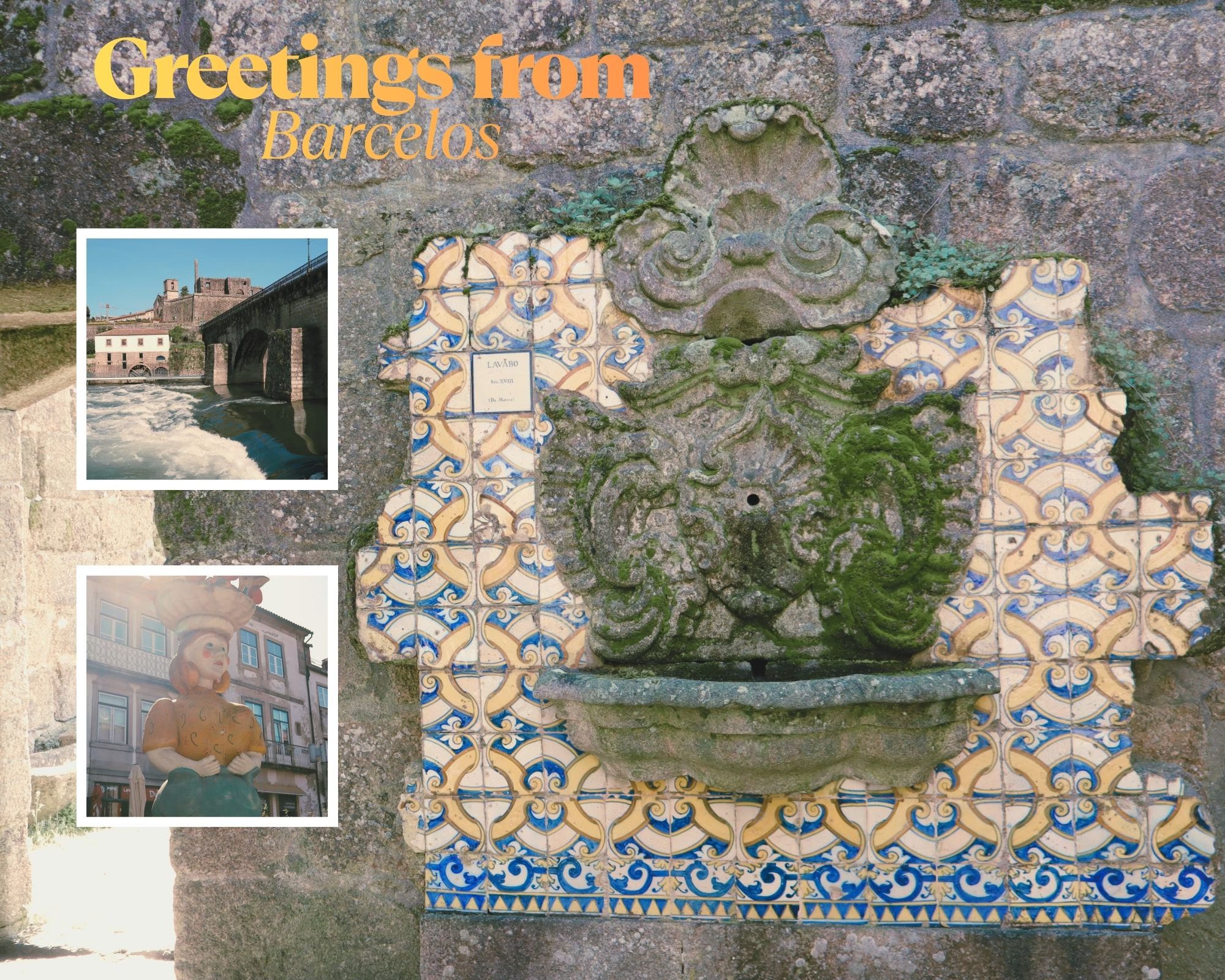
At last, I hear you cry! An actual postcard! And, yes, I did spend far too long playing with my photographs from the trip to mock up that postcard but humour me in my dotage, please 😉
So last week the sun returned, and as we eyed up our ‘empty diary’ days (for folks who are retired/semi-retired, those are still remarkably few) we proposed the long postponed trip to Barcelos’ famous Thursday market would both fill the day and tick somewhere else off our yellowing, dusty list.
Now please don’t be offended but we are not especial fans of Portugal’s general markets for what they sell - although the fresh produce in all its multicoloured glory is something else: the verdancy of the brassicas, the sheen of capsicums, the frilliness of the lettuces, the plumpness of the tomatoes, the glow of citrus, the vats of beans and olives and … you get the picture - all that delights my heart. And there always seems such pride in the sellers, you see it in their faces as they select the biggest, juiciest, heftiest version of whatever it is you request.
But beyond the food and the flowers, markets here are otherwise usually lined by stall after stall decked in gaudy underwear, or hung with clothing whose provenance we probably don’t want to consider, or filled with kitchenware, or garden pots, or tools, or haberdashery or pottery roosters or or or …
… actual livestock squashed into tiny cages, or here actually still strutting proudly around, blissfully unaware they’re being eyed up for the dinner pot. We glimpsed three huge bunnies jammed into battered cardboard box. Our vegetarian souls bleated in pain, and we hurried away, wondering whether we might return to liberate them…
For many, these markets are a treasure trove. And Barcelos may be the glitteriest of them all.
Yet, market day - as Barcelos reminded us - is always about so much more than picking up your vegetables from local growers instead of at the supermarkets that are no more than a 10 minute walk away, or finding that David Bowie T-shirt you’ve always wanted (no, seriously, you know you have) for 8 euros, or another terracotta baking dish because you can really never can have enough of those…
Market day, especially when the sun shines after weeks of rain, seems to draw everyone out. All ages, all classes, locals and those from further afield, and here in Barcelos, too, the peregrinos on the Camino de Santiago de Compostela. And it somehow levels, it democratises, in its tactility and sensuality. Customers pick up lemons, turn them over, inspect them, sniff them - is the peel still too hard? does the flesh give just a little as you squeeze it? is the yellow just the right shade of yellow, not under- or over-ripe? - and all the while chatting to the seller who simultaneously stuffs paper bags with potatoes or beans or bunches of salsa for someone else. Pick, poke, sniff, squash - all to the tune of so much chatter. Yes, of course, it’s transactional but the transaction is about so much more than commerce.


And then once you’ve got your fruit and veg for the week, and picked up some extra socks, and maybe a mallet you didn’t know you needed, you can step into the main street that runs along the side of the market and is lined with cafés groaning with sugary pastries and cakes, where old and young, locals and estrangeiros, solo or in couples or groups, sit side by side, smiling in the sun, and enjoying the spring colour - colour everywhere: the long, neat rows of tulips, all reds and yellows; the unruly pinks, whites, mauves of the magnolias; the blues and whites of the azulejos on the building walls.
So much glorious colour, after all that leaden grey of the past few months.


But we discovered that Barcelos is also so much more than its market.
It’s an absolutely beautiful and very well-preserved small town, with a little 15th century castle just perched up above the river, replete with a water-mill that squats by the stone bridge connecting Barcelos to Barcelinhos (‘little Barcelos’). Its streets guide you without pressure, and on this February market day it did not take long to leave the crowds and find that tranquility that old Portuguese towns seem to emanate from the very stone of the buildings, and the cobbles that cradle your footsteps as you wander who knows where.
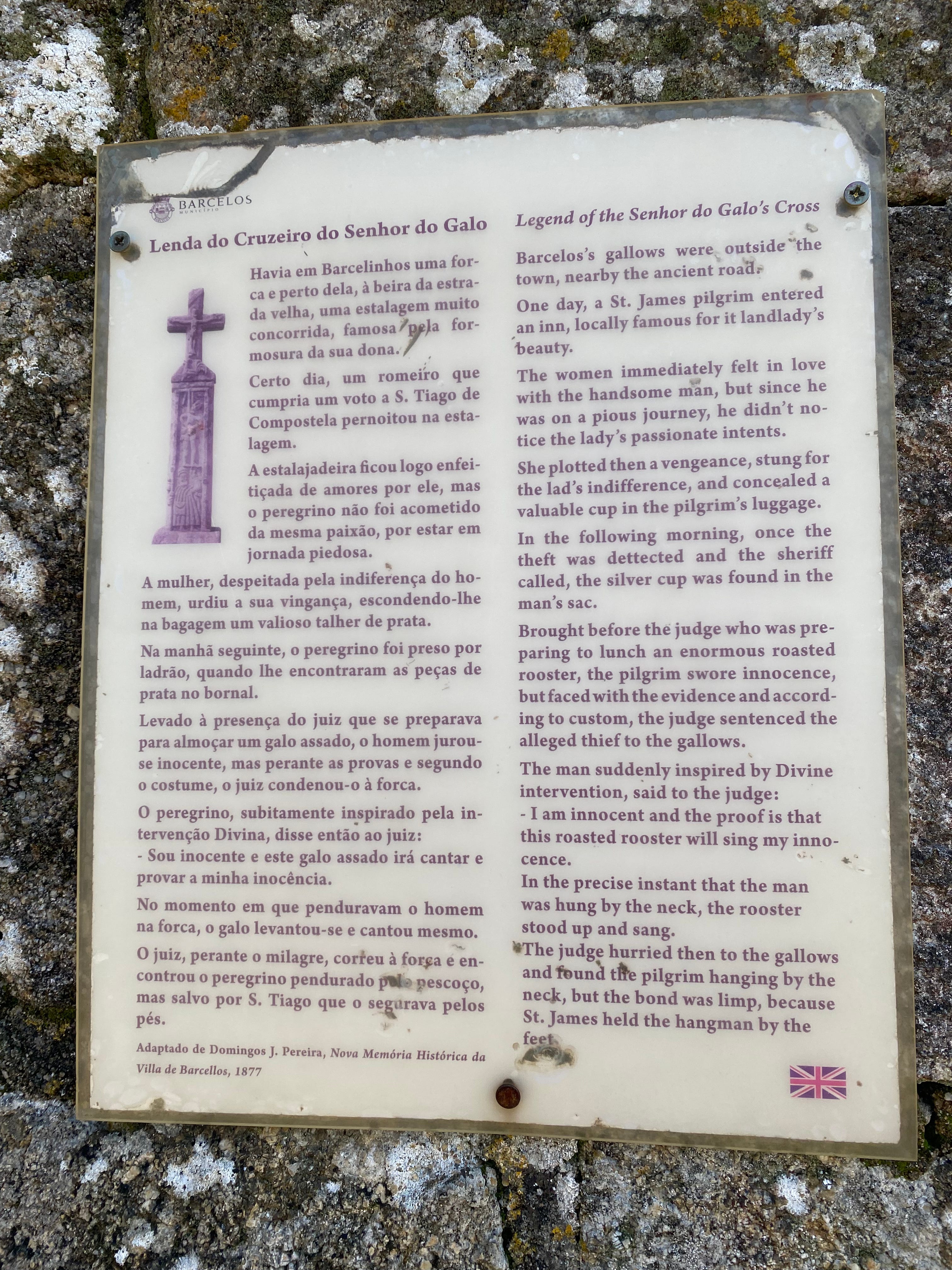
Inevitably, though, being the people we are, we found our way to the castle where we learned from a plaque on the wall about the legend of the galo de Barcelos, the origin story of Portugal’s national emblem and symbol of good faith and justice, and that explains the ubiquity of those heavily decorated black pottery roosters that now grace every gift shop and market stall in the land.
⚠️ The legend that is told below includes reference to hanging. Please feel free to skip past beyond the next photo of the story plaque if you want to.
The ‘net typically occludes the rather juicy detail of the revenge story of an amorous woman, renowned for her beauty, who cannot believe that her advances have been scorned by a handsome young pilgrim who stops off at her inn on his way to Santiago de Compostela. Furious, she plants a silver cup in his bag, and when the next day he’s accused of being a thief, he’s brought before the judge who happens to be about to sit down to eat roasted rooster for lunch. It’s an open and shut case, as far as the hungry judge is concerned, and the hapless pilgrim is sentenced to death by hanging.
But then, in a moment of divine inspiration, the young pilgrim proclaims his innocence, asserting that the roasted rooster will prove it by singing:
…este galo assado irá cantar e provar a minha inocência1.
Just as the pilgrim is hanging on the gallows, the rooster starts to sing from the lunch table and the judge races to find that the pilgrim is alive, with St James holding the hangman by the feet, and the rope still loose.
Maybe we should have liberated those roosters after all?!
After the castle, I think we both sensed our old internal clocks starting to sound the alarm - we’d been out for nearly 3 hours, surely we needed to start heading back? - but the warmth of the sun and the pull of the river path we could see on the other side of the Rio Cávado lured us on, across the old stone bridge, that joins ‘Big’ Barcelos with ‘Little’ Barcelos.
Although the walk runs for 14kms all the way to the coast at Fão/Esposende, that was never going to be our destination, and we ambled along for just a couple of them, enjoying all the signs of spring starting to spring, noting just how high the river must have risen during the storms, leaving the path soggy and small trees fallen across it in parts, and stopping to have a chat with a dog-walker who introduced us to her very happy, waggy-tailed dogs, one called Zeus, and the other something else, but obviously not as memorable as that of the rather scruffy-looking mutt named after the King of the Gods!
Barcelos captivated us. Its beautiful architecture and gentle streets, its castle and river, its rooster and legends and the presence of the Camino de Santiago marked all around the town offered us everything we enjoy in a place. We plan to revisit. Although probably not on market day 😉
Do you have a favourite market? What (if anything!) do you enjoy about market days?
Where would you choose to visit if you found yourself with a free day and a tank-full of petrol or a train ticket?
- feel free to drop me some answers if you want to, but no pressure! I’m just curious 😊
Coming soon
Believe it or not, I still have ‘February Flittings’ in the pipe-line - hopefully with you before March is out! - along with two or three book reviews still to come, and of course these regular weekly postcards.
I have recently managed to reinvigorate my old reading habit, a habit that has suffered greatly in recent years thanks to being suffocated by social media and doom-scrolling (but also somewhat by just being a Literature teacher and having to read tens of books at speed to teach) and I am absolutely loving it.
Instead of picking up my phone while I eat breakfast, I open my book. If I’m taking the metro or going to a cafe to meet a friend, I take my book and read that while I wait, even if it’s only for 10 minutes. The irony is that it’s a digital tracker that’s helped me to do this, but what it has done is show me how many pages I can read in an hour, which basically means that if I were to spend the same amount of time reading a book as I typically spend on my phone, I could read ONE WHOLE BOOK A DAY!
That just shamed me into action.
It’s not just that the book is replacing the never-ending gloom beamed in by FB etc, but that it makes me think differently. Instead of flitting from fragment to fragment on the screen, forgetting what I’ve read seconds after reading it, my thoughts are sustained and supported, allowed to linger, deepen, and wander but at my beck and call, not that of the algorithm.
I feel healthier for it. Less stressed. More steady.
I think more and more of us are reverting to old analogue practices, and rediscovering the joy of them. Last Saturday, I went to a collage-making workshop where for 90 minutes I sat like a kid in kindergarten contentedly sticking dried flowers and foliage onto pieces of card and using old book pages to assemble some kind of montage that held meaning for me I’d struggle to articulate in words. So I’ll end with some words by someone who always makes sense:
…all the same, there’s something about me that doesn’t change, hasn’t changed, through all the remarkable, exciting, alarming, and disappointing transformations my body has gone through. There is a person there who isn’t only what she looks like, and to find her and know her I have to look through, look in, look deep. Not only in space, but in time. - Ursula Le Guin2
Thank you for reading, and I look forward to hearing any news or views you may want to share, too!
Até logo, os meus amigos!
Michelle 🦋
Written on a plaque on the castle wall. Adapted from Domingos J. Pereira, Nova Memória Histórica da Villa de Barcellos, 1877
Cited in ‘The Marginalian’ by Maria Popova: https://www.themarginalian.org/2014/10/21/ursula-le-guin-dogs-cats-dancers-beauty/
This post brings me back to touring this region three years ago. From Porto up the coastline, as far as Vigo in Spain and back down to Barcelos and Braga. We loved the villages and towns discovering a wealth of traditional crochet crafts in the region. We stopped in Barcelos for a few hours and your description is exactly as I remember it, but we were there in July and it was hotter. I love market towns. For a day trip to a market town we go to Kenmare in South Kerry. I posted an article about it last summer. Lovely article Michelle. Isn't reading books such a blessing in these crazy times 📖🥰
I have filed this for reading later. I am off to Ennis Book Club festival this morning til tomorrow 📚📖🤗